
Tichelmann: an equal path to every radiator.
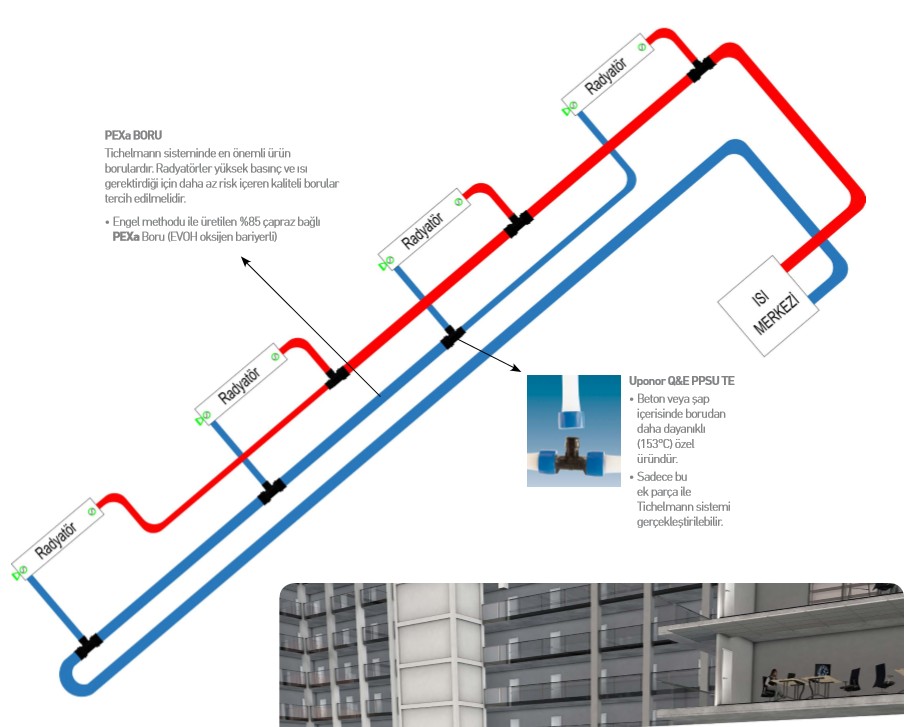
If you have PEXa pipe and Q&E, you connect radiators with the Tichelmann (reverse return) system. The radiator closest to the heat source and the one furthest away see the same pipe length, so the installation balances itself.
First in, last back.
In a conventional connection, the return line goes back to the heat source by the shortest route from the nearest radiator. In Tichelmann, the return is collected in the reverse order of the flow: the radiator fed first walks the longest path on the way back.
The nearest radiator wins
R1’s circuit is short, R4’s is long. Water takes the easiest path; nearby radiators heat up quickly while distant ones heat late and little. Balancing requires adjusting each one with balancing valves.
Every radiator is equal
The return line starts at R1, passes R4 and goes back to the heat source. Flow plus return is the same for every radiator; pressure loss is equalised and flow distributes itself evenly.
With Tichelmann, the line is flat.
Flow + return pipe length for each radiator on an example line with four evenly spaced radiators. In a conventional connection, the furthest radiator’s circuit is 4 times the nearest; with Tichelmann they are all equal.
The pipe itself creates the balance.
Even heating
Because every radiator sees the same pressure loss, the flow is distributed evenly; the room at the end of the line warms up at the same time as the first.
Fewer adjustments, fewer valves
Pipe geometry provides the hydraulic balance; balancing valve adjustment and commissioning time are reduced.
Efficient pump
There is no need to run the pump harder than necessary to get enough water to the distant radiator.
Two parts make the system possible.
Radiators run at high temperature and pressure; in Tichelmann lines, the quality of the pipe and fittings determines the system’s lifetime.
PEXa Pipe
In a Tichelmann system, the most important product is the pipe; choose a quality pipe that carries the least risk for radiator lines.
- PEX-a, 85% cross-linked, produced by the Engel method
- With EVOH oxygen barrier
Uponor Q&E PPSU TEE
Every radiator branch on the flow and return lines is made with this tee. It is a special part that can safely stay embedded in concrete or screed.
- More durable than the pipe in concrete and screed
- PPSU material resistant to 153 °C
- Q&E: the expanded pipe settles tightly onto the tee by itself
Let’s design your Tichelmann line together.
Talk to our team about radiator layout, pipe diameter and the bill of materials.